

Pinch Grip vs. Power Grip: Why Some Containers Feel Impossible
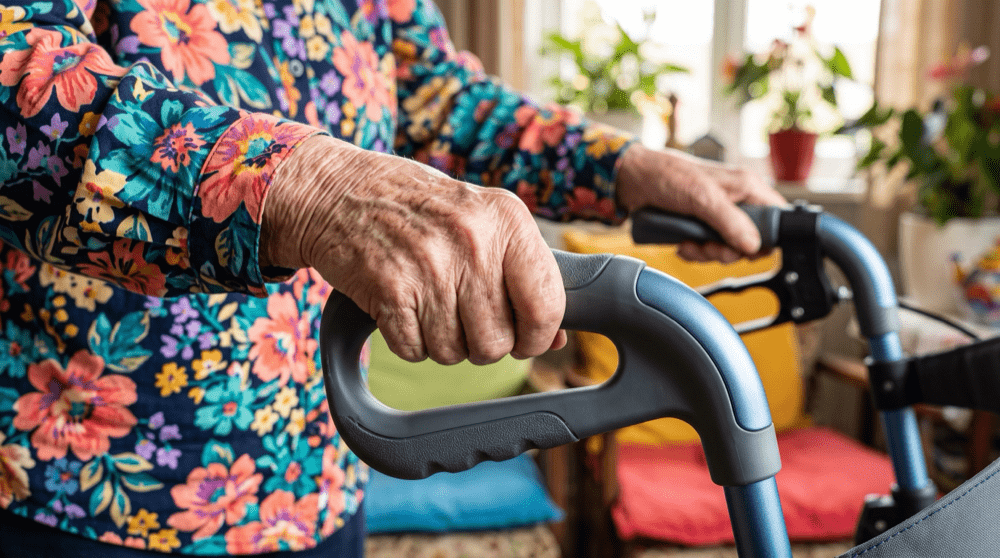
Some objects ask for your whole hand. Others ask only for your fingertips. A jar lid fills the palm. An eye drop bottle cap barely fills the space between a thumb and a finger. Both twist the same way, yet one can feel easy and the other nearly impossible. The difference is not the lid. It is the grip the lid allows.
In 1956, the anatomist John Napier described two basic ways the human hand holds things. In a precision grip, we pinch an object between our fingertips and thumb. In a power grip, the object sits "as in a clamp between the flexed fingers and the palm." Precision grips give us control: threading a needle, turning a page, winding a watch. Power grips give us force: swinging a hammer, carrying a bag, opening a stubborn jar.
A typical adult's fingertip pinch is only about one-fifth to one-quarter as strong as their full-hand grip. Men in their twenties averaged about 121 pounds of grip force but 26 pounds of pinch force; women averaged about 73 and 18.
— Adapted from Mathiowetz et al., Archives of Physical Medicine and Rehabilitation (1985)
A small cap leaves no choice. An eye drop cap measures 17 to 19 millimeters across, about the width of a U.S. dime. There is no room for a palm, so the work falls to the fingertips, the weakest grip we have.
Size then works against us twice. How hard we can twist depends on how hard we squeeze, how much friction the surface offers, and how far from the center our fingers sit. A narrow cap shrinks both the surface and the distance. Researchers found that twisting strength rose as lid diameter grew from 20 to 50 millimeters. An eye drop cap sits below the smallest size they tested. The same study found that square lids allowed more twisting force than round lids of the same width. Shape matters, not just size.
Good tools don't make us stronger. They move the work to where we are already strong. A jar wrench, a key turner, and a lever-style faucet handle all trade a fingertip task for a whole-hand task. They add size, so the hand can wrap around instead of pinching. They add leverage, moving the turning force farther from the center. They add stability, holding the object still so one hand isn't fighting the other.
That last point is easy to miss. Opening a bottle is two jobs at once: one hand holds, and the other turns. With a tiny bottle, both hands are pinching. Neither gets to use a power grip.
That idea shaped our Eye Drop Bottle Opener Set. We split the job in two. The Comfort Grip Handle holds the bottle steady, so the holding hand wraps around a handle instead of pinching a small, slippery cylinder. The Gentle Turn Wrench fits over the cap and gives the turning hand something larger to hold. Its flexible, textured surface conforms to the cap and adds friction, so a modest squeeze becomes a firm twist. The set fits most standard 2.4mL bottles with 17 to 19 millimeter caps. The bottle stays the same. The grip changes.
Designers talk about affordances and signifiers, the abilities and cues that tell us how to use an object. Grip is an affordance, too. A small cap tells every hand to pinch, whether pinching suits that hand or not. When an object feels impossible, the problem is rarely the person. It is the grip the object demands. Improve the grip, and the product improves with it. Improve the product and the person using it has an easier – and improved – experience.
See how the set works in our how-to guide, or find it in our Etsy shop.
Sources
- Napier, J.R. (1956). The prehensile movements of the human hand. Journal of Bone and Joint Surgery. Source of the two grip types and the quoted definition.
- Mathiowetz, V., et al. (1985). Grip and pinch strength: normative data for adults. Archives of Physical Medicine and Rehabilitation. Figures taken from the University of Michigan's tables of the study: grip strength and lateral pinch strength (right hand, ages 20–29).
- Crawford, J.O., Wanibe, E., & Nayak, L. (2002). The interaction between lid diameter, height and shape on wrist torque exertion in younger and older adults. Ergonomics. Source of the 20–50 mm diameter finding and the square-versus-round finding.
- Eye Drop Bottle Opener Set listing, UU Workshop on Etsy. Product parts and fit range.